Industries rely on reliable communications to connect people, machines, vehicles, sensors and operational systems. As factories, mines, oil and gas facilities, ports and other industrial sites become more automated, the need for secure and continuous wireless connectivity continues to grow.
Traditional Wi-Fi, wired networks and public mobile networks can support many industrial applications. However, they may face limitations when large coverage areas, moving equipment, high device density, traffic prioritization or local network control are required. These challenges become more important when communication failures can interrupt production, affect worker safety or disrupt essential operations.
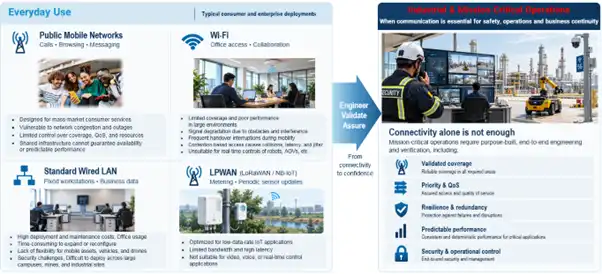
Non-Public Networks (NPNs) provide dedicated wireless connectivity usually using 4G LTE, 5G or a combination of both. They allow organizations to manage connected devices, control network access, prioritize important traffic and connect mobile equipment directly to their industrial applications.
Key Technical Benefits of NPNs
| Capability | Practical Benefit |
|---|---|
| Wide-Area Coverage | Connects users and equipment across large industrial sites, outdoor facilities, warehouses and remote operating areas. |
| Reliable Mobility | Supports communication for moving workers, vehicles and equipment across multiple LTE/5G cells. |
| Traffic Prioritization | Allows important applications such as operational voice and monitoring to receive differentiated QoS treatment. |
| Network Security | Uses SIM-based authentication and controlled network access, supported by additional enterprise security policies. |
| Local Data Processing | Keeps selected application traffic within the industrial facility through local gateways or UPFs. |
| High Device Capacity | Supports network designs for large numbers of connected devices, subject to radio capacity and core configuration. |
| Operational Control | Provides visibility into connected devices, traffic, radio performance and network status. |
| Flexible Expansion | Allows additional radio sites, devices and computing resources to be introduced as requirements grow. |
End-to-End NPN Architecture
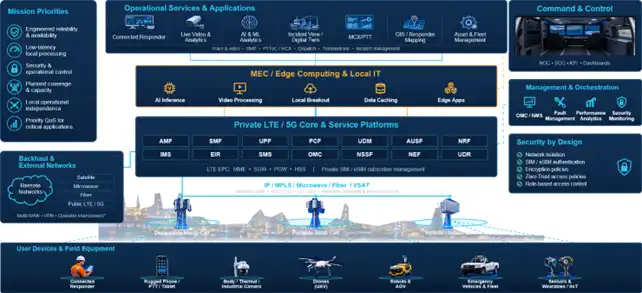
A NPNs consist of several interconnected layers. The design must address the full communication path from industrial devices and radio access to the mobile core, edge applications, enterprise systems, security and network management.
5G NPN Deployment Models
5G plays a key role in industrial digitalization, providing the high-speed, reliable and low-latency connectivity required for smart manufacturing, industrial automation, robotics and Industrial IoT. 5G NPNs enable industries to build secure and flexible connectivity environments tailored to their operational needs.
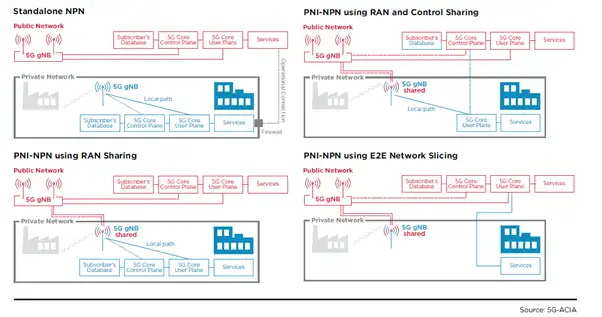
Standalone NPN (SNPN)
A fully dedicated private 5G network with its own core and RAN infrastructure, providing local subscriber management, data processing and full control over network operations.
Shared RAN with Dedicated Core
Uses the operator's shared radio infrastructure while maintaining a dedicated private 5G Core for enterprise services and traffic management.
Shared RAN and Control Plane
Shares RAN and selected core control functions with the operator, while using a dedicated local UPF for local data routing and application access.
Operator-Integrated Network Slicing
Uses the operator's shared 5G infrastructure to provide a logically isolated network slice with dedicated QoS, traffic policies and service characteristics.
Some NPN use cases for Industry 4.0
- Connected Workers: Support voice, video communication, remote assistance and Push-to-Talk (PTT) services through connected devices.
- AGVs and Mobile Equipment: Enable wireless connectivity and mobility management for automated vehicles, robots and industrial equipment.
- Industrial IoT and Monitoring: Connect sensors and machines for real-time monitoring, energy management and predictive maintenance.
- Video Analytics and Quality Inspection: Support industrial video streaming, AI-based inspection and local edge processing.
- Asset Tracking and Location Services: Enable equipment tracking, asset management and location-based applications.
- Digital Factory: Connect manufacturing systems, digital twins and industrial applications through a unified wireless infrastructure.
Advanced 5G Capabilities for Industrial Networks
Certain industrial applications require more than conventional mobile broadband. The 5G system includes capabilities designed to support advanced industrial communications.
- 5G LAN-Type Services: Enable LAN-like connectivity between compatible devices over 5G, supporting AGVs, mobile equipment and industrial systems across large facilities.
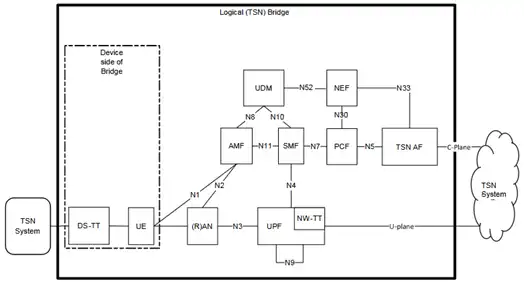
- Time-Sensitive Networking (TSN): Integrates 5G with IEEE TSN to support time synchronization and predictable communication in industrial Ethernet environments.
- Network Slicing and QoS: Enables differentiated traffic policies and quality of service for industrial applications such as video, voice, monitoring and control with logical network separation where supported.
NPNs Applications and Key Requirements Across Industries
| Industry | Applications | Key Network Requirements |
|---|---|---|
| Manufacturing | AGVs, industrial IoT, production monitoring, video inspection and connected workers | Indoor coverage, mobility, QoS, local processing |
| Oil & Gas | Field communications, remote monitoring, connected workers and inspection systems | Wide-area coverage, network resilience, secure OT connectivity |
| Mining | Fleet management, equipment tracking, remote monitoring and mobile communications | Rugged equipment, mobility, large-area coverage |
| Ports and Logistics | Container tracking, vehicle connectivity, asset management and video analytics | Outdoor coverage, capacity, mobility and edge services |
| Utilities and Power Plants | Equipment monitoring, field maintenance and operational communications | Reliable access, security, coverage of distributed assets |
| Airports and Campuses | Facility management, surveillance, mobile staff and operational systems | Indoor/outdoor coverage, mobility and traffic management |
| Public Safety | Connected responders, video communications, dispatch and mobile command | Resilient connectivity, rapid deployment and priority services |
| Remote Industrial Sites | Telemetry, workforce connectivity and local monitoring | Independent operation, reliable backhaul and secure device access |
Telcolabs NPN Solutions
Telcolabs provides end-to-end NPN solutions for industrial, enterprise and mission-critical applications. Our services cover the complete network lifecycle, from requirements assessment, network planning and solution design to equipment supply, deployment, system integration, testing, optimization and technical support. Our solutions include radio access networks (RAN), mobile core networks, MEC, voice services, security and centralized network management.
Whether for a single industrial site, a large enterprise campus, multiple locations or a portable network, Telcolabs delivers complete NPN solutions tailored to each customer's operational and technical requirements.