With the rapid advancement of network technologies and the widespread adoption of smartphones and laptops, mobile connectivity has become an essential part of everyday life. Unlike traditional fixed-line communication, modern mobile devices enable users to access the Internet, upload and download data, and seamlessly use a wide range of online applications and digital services.
Long Term Evolution (LTE) and the Evolved Packet Core (EPC) represent a major evolution of mobile communication networks, building upon earlier GSM/EDGE and UMTS/HSPA technologies. By introducing advanced radio access technologies and an enhanced core network architecture, LTE delivers significantly higher data rates, increased network capacity, improved spectral efficiency and a better user experience.
The EPC is the IP-based core network architecture of LTE, designed to provide packet-based connectivity and integrate different access technologies.
Telcolabs supplies EPC platforms for operators extending their LTE infrastructure, service providers building dedicated wireless broadband networks and enterprises deploying private LTE.
The system can be delivered as a compact integrated solution or as a virtualized platform running on supported server infrastructure.
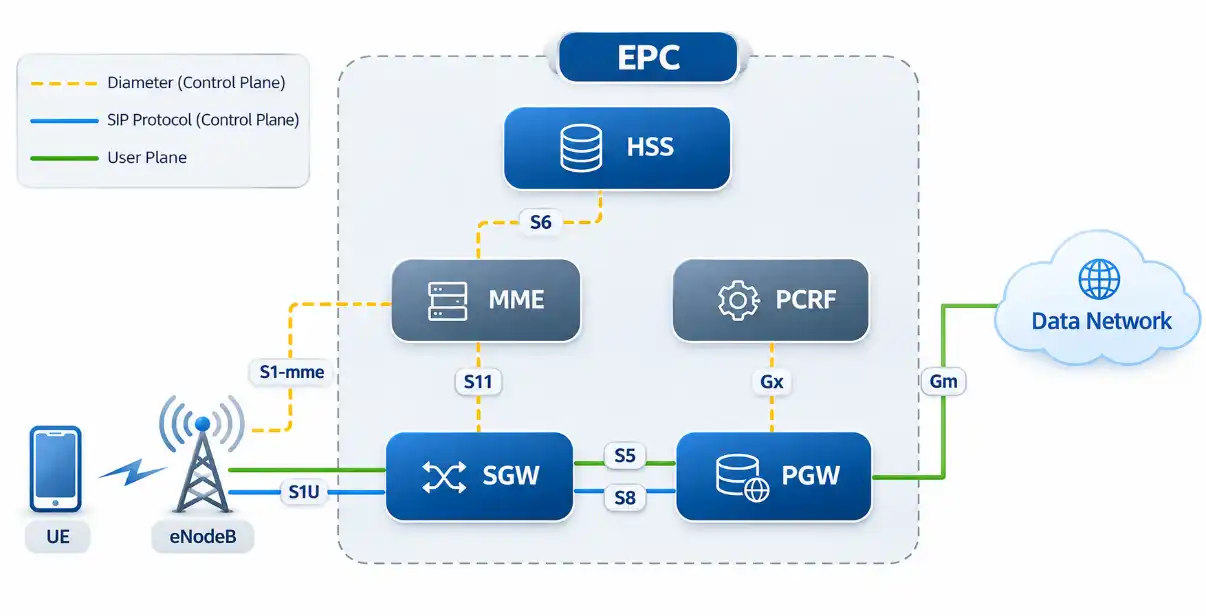
Architecture and Functions
The platform includes four principal network elements.
Mobility Management Entity (MME)
The MME manages LTE signaling procedures associated with subscriber attachment, mobility, tracking area updates and bearer control. It also coordinates authentication with the subscriber database.
Home Subscriber Server (HSS)
The HSS maintains subscriber profiles, authentication information and LTE service parameters. Subscriber provisioning and access restrictions can be managed through the relevant administration functions.
Serving Gateway (SGW)
The SGW forwards user traffic between the LTE radio access network and the packet data gateway. It also provides user-plane anchoring for supported mobility procedures.
Packet Data Network Gateway (PGW)
The PGW provides connectivity to external IP networks, assigns subscriber IP addresses and applies relevant policy, charging and QoS rules.
Product Specification
EPC General Software Specifications
| Property | Specification |
|---|---|
| 3GPP Compliance | 3GPP Release 12 |
| Network Functions | MME, SGW, PGW, HSS |
| Subscriber Capacity | License-based, to 1M subscribers |
| Data Throughput | Up to 10 Gbps, depending on configuration |
| Deployment Options | Virtual Machines (VM), Cloud Infrastructure, Docker-based deployments |
| Network Management (OMC) | Subscriber data management, system configuration, operational monitoring, alarm and log collection, system backup |
Packet Data Network Gateway (PGW)
| Property | Specification |
|---|---|
| Subscriber Capacity | to 1M subscribers |
| Data Throughput | Up to 10 Gbps |
| Interfaces | S5/S8, Gx, SGi, Ga |
| Session Management | EPS bearer establishment, modification and release |
| IP Address Allocation | IPv4 address assignment through locally managed IP pools |
| Data Forwarding & Routing | GTP-based forwarding toward SGW and external IP connectivity through SGi |
| Charging | Online charging functionality |
| QoS Management | QCI, ARP, GBR, DSCP marking and APN-AMBR management |
| Policy Enforcement (PCEF) | Enforcement of policy and charging rules received from PCRF |
| PCC Support | Static PCC rule configuration and policy-based bearer management |
| Bearer Control | Dedicated bearer establishment and modification initiated by the UE or network |
| Overload Protection | Rule-based control of excessive signaling and service requests |
Home Subscriber Server (HSS)
| Property | Specification |
|---|---|
| Subscriber Capacity | Up to 1M subscribers |
| LTE Interface | S6a |
| IMS Interfaces | Cx, Sh (when IMS functionality is deployed) |
| Subscriber Management | Subscriber creation, modification, deletion and profile templates |
| Authentication | EPS-AKA authentication and Ki, OP and OPc management |
| Mobility Management | Subscriber mobility records, UE reachability and roaming-area restrictions |
| Roaming Support | Subscriber roaming restrictions and local breakout support |
| Access Control | Subscriber admission control based on access type |
| IMS Integration | IMS subscriber profile and authentication data management |
| SNMP Management | Parameter management, operational status monitoring and subscriber data administration |
Mobility Management Entity (MME)
| Property | Specification |
|---|---|
| Subscriber Capacity | Up to 1M subscribers |
| eNodeB Capacity | 1 to 1,000 eNodeBs |
| LTE Interfaces | S1-MME, S6a, S11, S10 |
| Access & Security | Subscriber access control, authentication coordination and admission management |
| Mobility Management | Attach, detach, handover, Tracking Area Update (TAU), paging and service request handling |
| UE Management | UE state management, tracking area management and subscriber access restrictions |
| Session Management | EPS bearer activation, modification and deactivation |
| Multiple PDN Connections | Support for multiple PDN connections per subscriber |
| QoS Management | UE Aggregate Maximum Bit Rate (UE-AMBR) management |
| Gateway Selection | SGW and PGW selection |
| MME Pooling | MME pool operation and signaling load distribution |
| Overload Control | Rule-based rejection or restriction of requests under overload conditions |
| APN Management | APN validation and correction |
| Subscriber Restrictions | Operator Determined Barring (ODB) support |
Serving Gateway (SGW)
| Property | Specification |
|---|---|
| Subscriber Capacity | to 50,000 subscribers |
| Data Throughput | Up to 10 Gbps |
| LTE Interfaces | S1-U, S11, S5/S8, Ga |
| Session Management | EPS bearer establishment, modification and release |
| Network-Initiated Procedures | Support for bearer procedures triggered by network-side service requests |
| Mobility Management | User-plane mobility anchoring, packet buffering and handover support |
| Data Forwarding | GTP-U packet forwarding between eNodeB and PGW |
| Handover Support | End-marker handling during eNodeB handover |
| QoS Control | QCI, ARP, GBR and DSCP marking |
| QoS Modification | UE-initiated and network-initiated QoS updates |
| Charging | Charging-related functions supporting prepaid and postpaid services |
| Overload Control | Rule-based management of excessive requests |
| SGW Pooling | Support for SGW pool configurations |
LTE Service Capabilities
The EPC platform supports the network procedures required for LTE packet data services, including:
- Subscriber authentication and EPS bearer management.
- Mobility and handover between LTE cells.
- APN configuration and IP address allocation.
- QoS handling using LTE bearer parameters.
- Policy and charging integration through supported interfaces.
- User and system administration, monitoring and alarm reporting.
For LTE voice services, the EPC can be integrated with an IMS platform. VoLTE deployment requires the appropriate IMS configuration, radio network settings, QoS policies and compatible terminals.
Deployment Options
Compact EPC
The compact EPC combines the main LTE core functions in a small hardware platform. The reference system includes MME, SGW, PGW and HSS, with IMS available as an optional component.
Virtualized and Higher-Capacity EPC
For larger installations, the EPC functions can run on virtualized server infrastructure. The product family includes configurations with licensed subscriber capacities ranging from hundreds to larger operator-scale deployments. Actual capacity and throughput depend on the hardware, enabled functions, traffic profile and software license.
Where EPC Fits
Private LTE remains a practical choice for enterprises that need managed wireless coverage, dedicated spectrum where available, controlled subscriber access and predictable connectivity across operational areas. Common deployments include utilities, manufacturing sites, warehouses, transport facilities, remote operations and wireless broadband services.
Telcolabs can deploy and integrate the EPC with third-party LTE radio equipment (if they have), IP transport networks, SIM provisioning systems and IMS where voice services are required.
4G/LTE Evolved Packet Core (EPC)
Telcolabs EPC provides a flexible core network platform for operators, service providers and enterprises deploying LTE and private LTE networks.