Indoor Mobile Coverage
Providing reliable mobile coverage inside buildings remains a challenge, particularly in dense urban areas, shopping malls, hospitals, offices, factories, and residential complexes. Building materials such as reinforced concrete, coated glass and metal structures can significantly weaken signals from outdoor macro cells. Basements and complex building layouts make coverage even more difficult. As a result, indoor users may experience poor signal quality, lower data speeds and interruptions to voice services. In crowded buildings, growing mobile traffic can also create capacity problems, even when outdoor coverage is adequate.
Traditional passive and active Distributed Antenna Systems (DAS) remain effective solutions, particularly for very small or large buildings and high-traffic venues. However, they can be expensive and complex to install, maintain and monitor, especially when coverage is needed across many smaller locations.
Indoor mobile coverage solutions using LTE/5G small cells and distributed radio systems offer a flexible alternative. However, improving indoor coverage involves more than installing additional radio equipment. These systems must be properly integrated with the operator's mobile core, backhaul network, security systems and centralized network management platform. They must also support reliable handovers between indoor and outdoor cells, minimize radio interference, maintain voice and data service continuity and prevent unauthorized equipment relocation.
Solution overview
A controlled In-Building Solution (IBS) uses operator-authorized LTE femtocells, 5G NR small cells or distributed radio systems to provide indoor coverage and capacity. Standalone small cells contain the applicable eNodeB or gNodeB functions. In a distributed radio deployment, the functional chain is pRRU → EU (Expansion Unit) → BBU (Baseband Unit). The BBU provides the applicable baseband/RAN processing and connectivity toward the operator mobile core through the relevant standardized interfaces; exact functional partitioning and transport depend on the vendor design. Depending on the transport domain, the deployment follows either a Trusted Backhaul or an Untrusted Backhaul architecture.
Trusted Backhaul Scenario
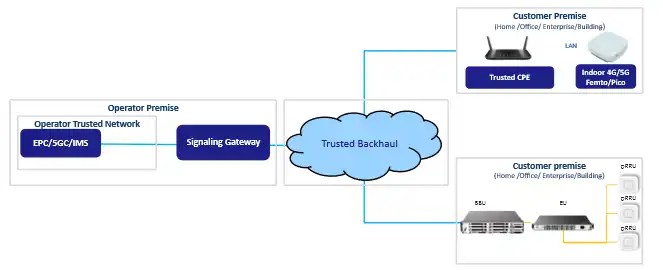
Trusted Backhaul applies when the IBS connects to the MNO (Mobile operator) network through an operator-approved, controlled or contractually trusted IP transport path.
In this Trusted Backhaul scenario, IP-layer encryption is not mandatory, provided that the transport network is considered trusted and complies with the operator's security policies. However, a Signaling Gateway is required to aggregate and manage IBS signaling traffic, control signaling connections toward the mobile core (MME/AMF) and ensure efficient and secure signaling management across multiple indoor cells.
Untrusted Backhaul Scenario
Untrusted Backhaul applies when the IBS uses customer internet, public PON, third-party fixed broadband, LTE/NR relay or any transport domain not fully controlled by the MNO.
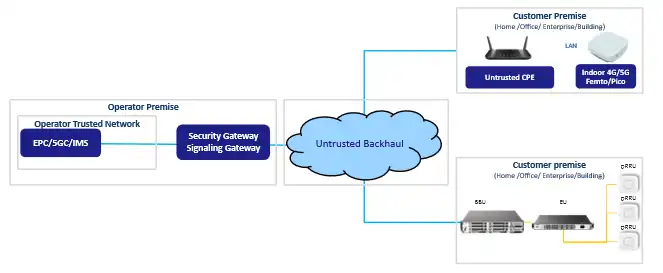
In this scenario, the proposed baseline is an IPSec tunnel from the IBS to at least the operator network edge or Security Gateway. This protects confidentiality and integrity, authenticates equipment and provides a controlled admission point before traffic reaches the MNO core. So, Security Gateway is required to terminate IPSec/IKEv2 tunnels, authenticate IBS devices, apply certificate or PSK policies, enforce whitelisting, separate traffic and protect the operator core. Also, Signaling Gateway is required behind or integrated with the security layer to aggregate signaling, proxy S1-MME/N2, control SCTP signaling, load balance MME/AMF selection and isolate the core from device-specific behavior.
Radio architecture: small cell and distributed pRRU
Integrated femtocell/small cell
An LTE femtocell implements applicable eNodeB functions and a 5G SA small cell implements applicable gNodeB functions, with standardized control-plane and user-plane connectivity toward the operator network. Installation parameters, radio bands, service profiles and access restrictions are controlled under the operator's provisioning policy.
Distributed radio (pRRU → EU → BBU)
The pico Remote Radio Unit (pRRU) connects to an Expansion Unit (EU), which in turn connects to the Baseband Unit (BBU). The EU aggregates or distributes the supported radio/fronthaul connections, while the BBU provides the relevant baseband and RAN functions for the deployed architecture. User and control plane interfaces toward the mobile core originate from the appropriate RAN processing element, not from the pRRU as an independent core node. Fronthaul type, synchronization, EU fan-out and BBU capacity are product-specific.
Trusted and Untrusted Backhaul
| Aspect | Trusted Backhaul | Untrusted Backhaul |
|---|---|---|
| Transport | Operator-approved, controlled or contractually trusted IP transport | Public Internet, customer broadband or third-party IP transport not accepted as trusted |
| IPsec/IKEv2 | Optional, subject to operator security policy | Required in the proposed reference design from IBS to SeGW/operator edge |
| Security Gateway (SeGW) | Not mandatory in the baseline trusted design; may be added by policy | Terminates IPsec/IKEv2, authenticates devices and enforces access rules |
| Signaling Gateway (SiGW) | Recommended for signaling aggregation and core protection | Included in the proposed reference architecture after security termination |
| Signaling path | S1AP/NGAP toward MME/AMF through controlled signaling access | Protected transport to SeGW, followed by SiGW and core connectivity |
| User plane | S1-U/N3 connectivity to SGW/UPF through the approved user-plane path | S1-U/N3 carried through the protected access path to SGW/UPF, without traversing SiGW |
| Location controls | Operator policy-based; may use approved-site and backhaul identity | Layered device/site verification and restriction of unauthorized relocation |
Main Network Components
Indoor LTE and 5G Radio Layer
Integrated LTE femtocells use eNodeB functionality and 5G SA small cells use gNodeB functionality. In a distributed solution, the radio chain is pRRU → EU → BBU, and the BBU provides the core-facing RAN functionality according to the chosen implementation. Band support, carrier bandwidth, radio output power, fronthaul, synchronization and user capacity depend on the selected equipment.
Security Gateway (SeGW)
The SeGW is the protected entry point for indoor equipment accessing the network over untrusted IP transport. Its functions include tunnel termination, IKEv2/device authentication, certificate or approved credential policies, traffic separation and NAT traversal where supported.
Signaling Gateway (SiGW)
The SiGW aggregates or proxies compatible control-plane connections toward the mobile core such as LTE S1AP/SCTP and 5G NGAP/SCTP where the specific implementation supports those functions. Signaling rate control, core-node selection and load distribution may be applied. The SiGW is not a substitute for SGW or UPF user-plane forwarding.
Centralized NMS and Provisioning
The management layer maintains device inventory, approved installation sites, radio configuration, software versions, equipment status, alarms, KPI collection and logs. Southbound interfaces and northbound OSS integrations depend on radio-vendor and operator requirements. Provisioning should enforce device authorization before activating radio services.
Reference Indoor Radio Configurations
| Equipment | Reference Technical Characteristics |
|---|---|
| Residential LTE femtocell | LTE FDD, 2×2 MIMO, 2×50 mW; 32 concurrent users and 64 RRC-connected users in the referenced configuration. |
| Enterprise LTE femtocell | 2T2R, 2×250 mW, LTE Band 3; 48 active users and 96 online users; VoLTE, SON and supported handover functions subject to software configuration. |
| 5G NR indoor small cell | 3GPP Release 16 reference, 2T2R, 2×250 mW, SA/NSA variants, up to 100 MHz bandwidth and 128 active users; bands and transport interfaces depend on the selected model. |
| Distributed pRRU | pRRU, EU, BBU topology; the EU connects distributed radio heads to the BBU. Fronthaul medium, topology, supported bands, power and BBU capacity are product-dependent. |
Telcolabs provides comprehensive end-to-end indoor mobile coverage solutions, covering the entire project lifecycle from initial consultation, site survey and radio planning to solution design, equipment supply, system integration, deployment, commissioning, optimization and ongoing maintenance. Our capabilities include LTE and 5G indoor radio systems, integrated femtocells and small cells, distributed radio solutions, Security Gateways, Signaling Gateways and centralized Network Management Systems. By combining radio access technologies with secure connectivity, mobile core integration and centralized management, Telcolabs delivers scalable, reliable and operator-grade indoor coverage solutions tailored to the requirements of mobile network operators, enterprises and industrial environments.