Telcolabs 5GC is built on the 3GPP-defined Service-Based Architecture (SBA), introducing a modular and flexible approach to mobile core network design. By adopting Service-Based Interfaces (SBI) based on HTTP/2 and separating the control and user planes (CUPS), 5GC enables independent deployment, management and scaling of network functions. It provides the essential capabilities for 5G Standalone (SA) networks, including subscriber registration, authentication, mobility management, session control, policy enforcement and user-plane traffic processing.
Telcolabs provides 3GPP-compliant, cloud-native 5GC solutions that leverage Network Functions Virtualization (NFV) to decouple network functions from dedicated hardware. The platform supports deployment on Commercial Off-The-Shelf (COTS) servers, virtualized infrastructure and compatible cloud environments. This hardware-independent architecture enables flexible resource allocation, capacity expansion, simplified network operations and efficient software upgrades while reducing infrastructure complexity and deployment costs.
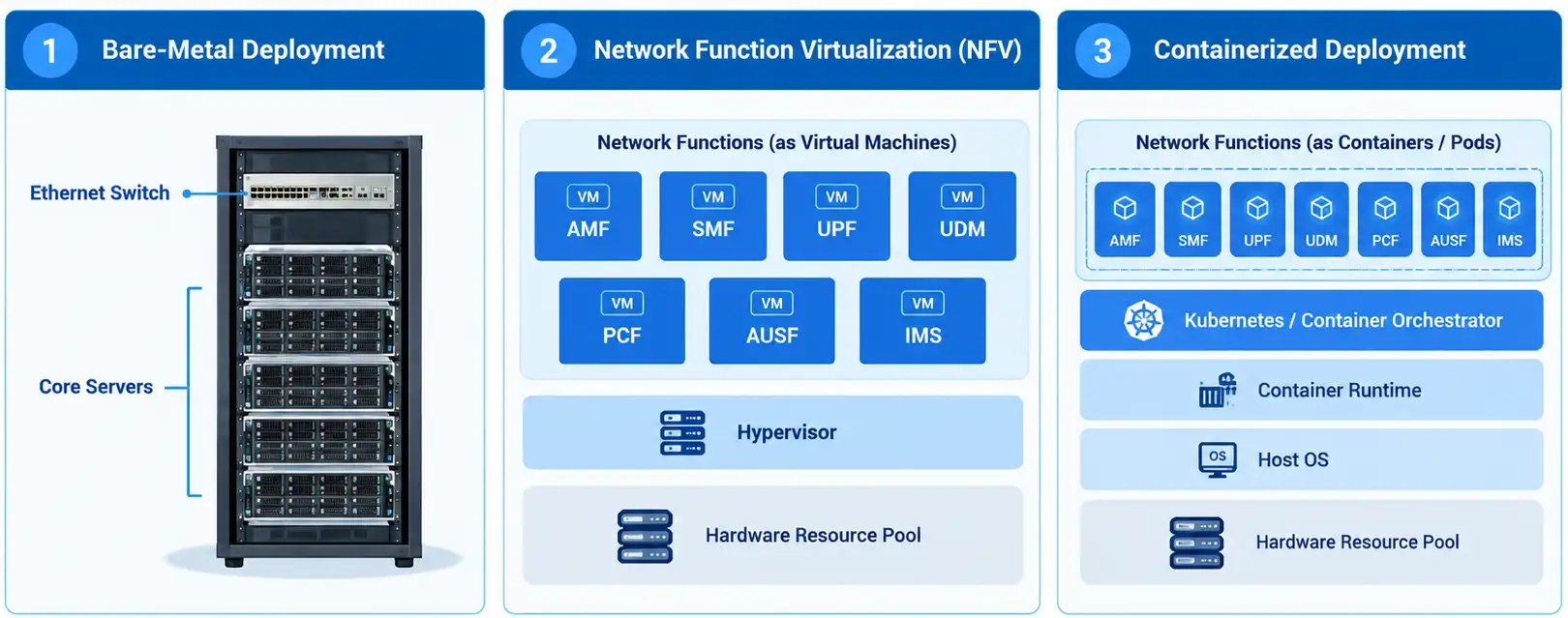
Designed for both public mobile networks and enterprise private 5G deployments, the Telcolabs 5GC supports scalable architectures ranging from compact, integrated systems to distributed networks with multiple radio sites and User Plane Functions (UPFs). It enables advanced capabilities such as network slicing, differentiated Quality of Service (QoS), local traffic breakout and Multi-access Edge Computing (MEC) integration.
Architecture and Functions
The 5GC platform incorporates the principal control-plane and user-plane functions required for 5G SA operation:
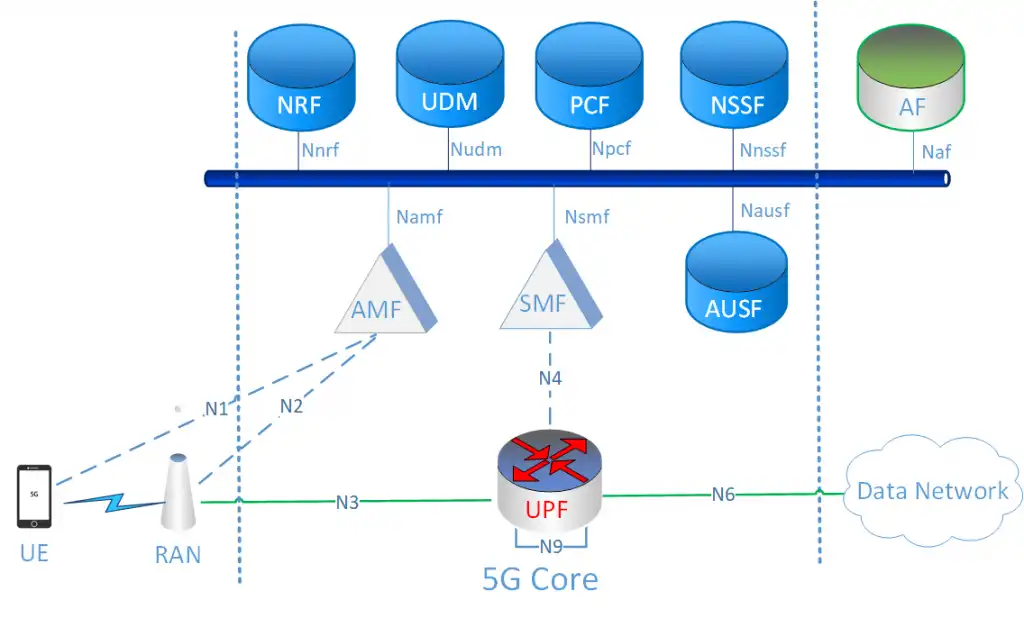
Network functions communicate through standardized service-based interfaces. The platform also supports the N2, N3 and N4 interfaces used for communication with the radio access network and for control of the user plane.
| Network Function | Description |
|---|---|
| AMF | Registration, access control and mobility management |
| SMF | PDU session establishment, modification and release |
| UPF | User traffic forwarding, QoS handling and local data-network connectivity |
| AUSF | Subscriber authentication |
| UDM/UDR | Subscriber data and identity management |
| PCF | Policy control and service-related rules |
| NRF | Registration and discovery of network functions |
| NSSF | Network slice selection |
Product Specification
| Property | Specification |
|---|---|
| Protocol | 3GPP Release 15/16, TS23.501, TS23.502, TS24.501, TS29.503, TS29.509, TS33.501, TS38.413 |
| Interface | N1/N2/N3/N4/N7/N8/N10/N12/N15/N26, NGAP, S1, HTTP/2, GTPV1/V2-C, GTP-U |
| Service interface | Naf, Namf, Nsmf, Nausf, Nudm, Nupf, Npcf, Nnssf, Nnrf |
| Capacity | License control, 100~1M Subscriber |
| User-plane processing | Single UPF ≥10 Gbps (supplier reference, hardware dependent) |
| OMC | Human-machine interface-based system management functions: • User data management • System configuration • System monitoring • Alarm and log collection • System backup |
Deployment Options
Compact 5GC
For sites that require dedicated 5G connectivity without a large server installation, the compact configuration brings the essential 5G Core functions into a small integrated system. It is intended for applications such as industrial campuses, private 5G demonstrations, research facilities and localized wireless networks.
Standard and Scalable 5GC
Larger networks can use a modular core configuration with network functions deployed on dedicated or shared virtualized infrastructure. Control-plane and user-plane resources can be positioned and scaled according to the network design.
Network Slicing and QoS
The platform provides network slice selection and policy management functions for 5G SA services. This allows operators to configure different logical service environments over common infrastructure.
In enterprise applications, network slicing can be used to distinguish operational traffic from general connectivity services. End-to-end implementation of slicing requires corresponding support from the radio access and transport networks.
QoS policies can be applied to individual sessions and service flows according to the requirements of the application.
Distributed UPF and Local Breakout
Not every application needs to send traffic through a central data center. The 5GC architecture allows UPF instances to be deployed near the radio access network (RAN) or enterprise application servers. Traffic destined for local systems can then remain within the site, while other services continue to use central network connectivity. This arrangement is useful for industrial video systems, connected machinery, edge applications and operational systems where local data processing is preferred.
Applications
The 5GC platform can be used in public mobile networks, private industrial 5G, campus networks, oil and gas, mining operations, ports, logistics facilities and controlled test environments.
Telcolabs provides network dimensioning, core configuration, RAN integration, subscriber provisioning, interoperability testing and commissioning services as part of the overall deployment.